
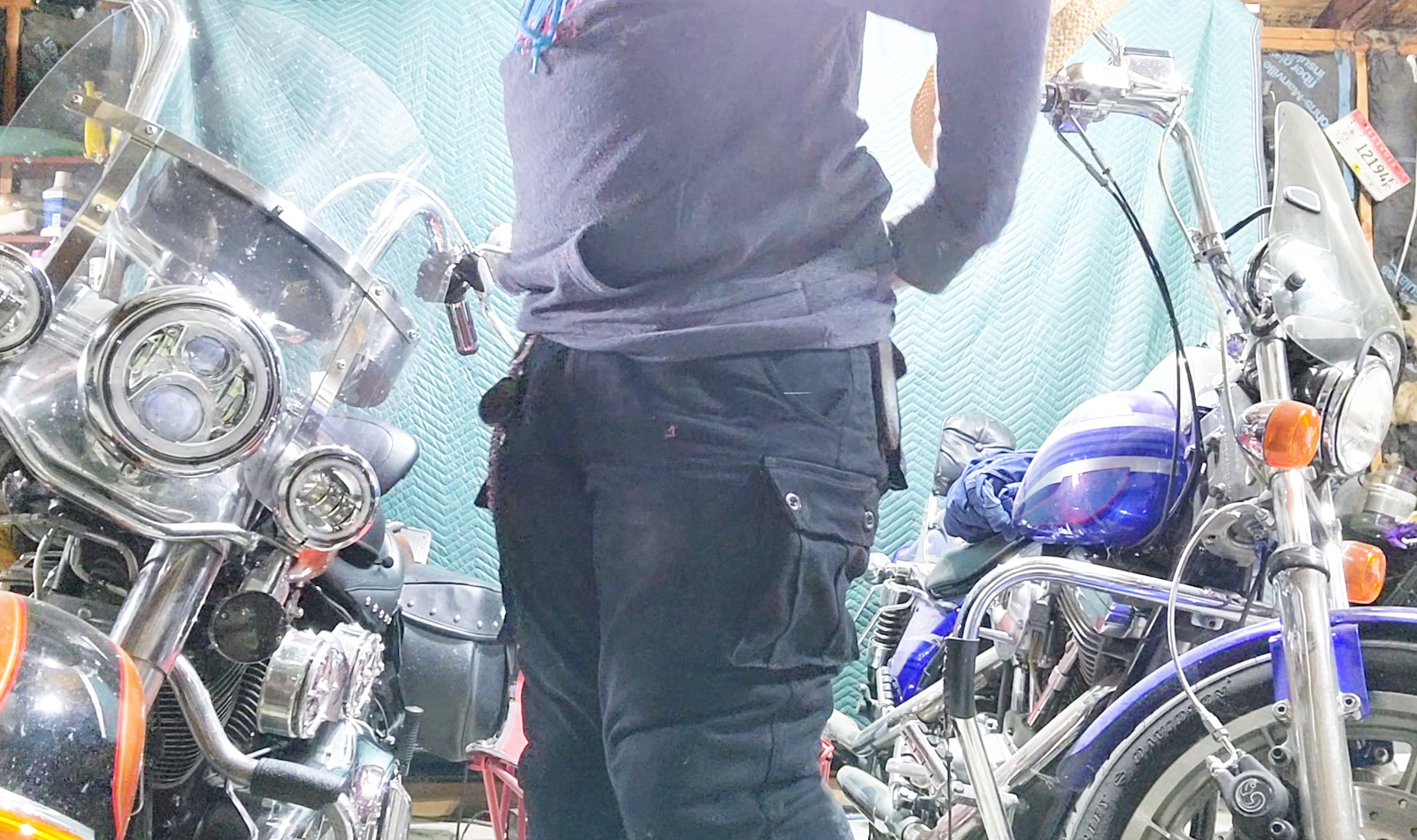
It seems like every year I see someone who does not care about the skin on their legs while riding. I have seen shorts, Capri’s, and even swim trunks. Why does this bother me? In the field as an EMT I have seen the damage that even a minor accident will cause to your skin. Do you know that when you get gravel, dirt and asphalt in your skin the only way to remove it at the hospital is to scrub it out with something like a Brillo pad? I don’t want you to have this so I am writing this to educate you on your options.
Shorts or swim trunks: First off with my bikes and my body build, I cannot even think of riding in shorts. I would burn my thighs on the engine/exhaust. Some of you don’t have this issue and ride fine without this problem. Shorts are cooler on hot days especially in an urban area where you don’t get much airflow. But you have very little protection from anything flying up off the road, thrown out of car windows, or god forbid if you go down. If you think about it, sliding on bare skin it would not take long to burn through all your skin to the muscle layer and even bone.
Leather or Kevlar Armored Pants: This is on the extreme other side from shorts. You can slide a long way before you burn through Leather or Kevlar armored or even the ones without the armor. They more than triple the time you can be sliding before your skin hits the pavement. The issue with these is they are HOT, even when vented they are warm. They are also expensive to buy. You see many sport bike riders/racers that wear these.
Capri’s: You know these are longer than shorts, but they don’t cover your ankles or lower calves that are popular. I see a lot of women riders wearing these with tennis shoes and even with crocs or sandals. The do cover more than shorts and are cooler than long pants but they are also usually made of light weight material and so are not much protection at all in the case of an accident.
Carhart/ Canvas /Firehose: Carhart is the brand name of a company that makes workwear used all over the world and it is known to be very strong and durable. I know from experience that even my EMT trauma shears have problems cutting the Canvas material that Carhart uses in its clothes. I personally like Carhart or Walls or there are other manufactures that make the same type of clothes. They last and are not too expensive. But of course, they also have drawbacks. They are hot in the summer. They are stiff especially when new.
I usually buy Men’s since they seem to last longer but to do that, I have to go up about two sizes above my normal because they have no give in the sizing. I put Firehose in this same area because I would think they are similar but I have not personally tried them yet. I want to but they are pricey and you have to order them over the internet so I can’t try them on. This makes me uneasy. They do have a few retail stores now but they are few and far between. So, if anyone has tried these, please let me know what you think. I have a friend who tried these. He said they were not good at keeping the bike heat away. He burned the crap out his leg when he wore them.
Dress Pants/ Slacks: Dress Pants or Slacks are long pants and do give some protection and I must confess to wearing them myself, but I do tend to wear thicker, EMT or Military BDU pants that are stronger. You should consider what the pants are made of when riding. Polyester will melt and that will cause even more issues.
Riding Jeans: These are jeans, you can buy that are made with Kevlar, Nomex, and/or armor. These are more costly but they are a step down from racing leathers. So, they would be very good for riding. They do tend to be stiff and usually need to go up a size to get the right fit.
Jeans: Jeans are the go-to pants for riding wear. Most people have several pairs and they will help protect in most crashes. They are not expensive (unless you have to have designer). Jeans from Farm stores seem to be made of a thicker denim and that is better protection. Be wary of the stretchy jeans. They are usually made with Spandex and that is a material that will actually melt when sliding down the road. It also may cause a burn to your skin if your bike runs hot and your let gets so hot the spandex starts to melt while you have them on.
Chaps: Most people wear chaps in the cold weather over jeans but I have seen them over shorts in the summer. I don’t personally like this but it is safer than shorts alone as long as the shorts are long enough no skin is exposed when you have the chaps on.
I suggest jeans at the least amount of protection when riding.
Here is information from a drag test I found on a rider chat site: Tear and Abrasion Strength by the numbers:
Pounds of force until fabric tears – Abrasion cycles on pavement until fabric fails
Cotton Jeans 4.5 pounds to tear 50 cycles to failure
70 Denier Standard Nylon 4.5 pounds to tear 165 cycles to failure
500 Denier Polyester 8 pounds to tear 180 cycles to failure
200 Denier Standard Nylon 7.5 pounds to tear 275 cycles to failure
500 Denier Cordura 22 pounds to tear 710 cycles to failure
620 Denier Cordura 35 pounds to tear 1200 cycles to failure
NEW Competition Grade Leather 80-110 pounds to tear 1200-1700 cycles to failure
1000 Denier Cordura 110 pounds to tear 1780 cycles to failure
Air Mesh Kevlar 1260 pounds to tear 970 cycles to failure Stretch Kevlar Blend 420lbs pounds to tear 1800 cycles to failure
This is how quickly some materials take to hole (Material: Seconds)
Denim: 0.2 to 0.5 seconds
Some race gloves: 0.6 seconds
Most leather gloves: 1.0 to 1.8 seconds
Keprotec stretch material: 0.9 seconds
Poor Kevlar: 1.0 seconds
Two layers of waxed cotton: 1.3 seconds
1.3mm thick cow hide: 3.8 seconds
Two layers of 1.3mm thick cowhide: 18 seconds
Three layers of 1.3mm thick cowhide: 55 seconds
Two layers of Kevlar plain weave: 5.6 seconds
Suede: 18 seconds
Boot leather (generally 2.2mm thick): 20 seconds
Leather stretch panels: 20.4 seconds
For the Drag Test, samples were stitched to a bag that held a 75-pound
sandbag inside a milk crate, then dragged behind a pickup truck…”
New, 100% Cotton Denim Jeans ———————– 3′ 10″
Senior Balistic Nylon ———————————— 3′ 10″
Leather, Lightweight, Nude Finish, 2.25 oz/sq. ft. —— 4′ 3″
Leather, Fashion Weight, 1.75 oz/sq ft. —————– 4′ 4″
Two-year-old 100% Cotton Denim Jeans ————— 4′ 5″
Cordura Nylon Type 440 ——————————- 18′ 3″
Kevlar 29 Aramid Fiber, Style 713 ———————- 22′ 1″
Leather, Competition Weight, 3 oz/sq. ft. ————- 86′ 0″
“Finally, protection from road abrasion cannot be guaranteed by a
materials abrasion resistance alone. A jacket may have panels of
highly abrasion-resistant materials, yet if low-quality stitching joins
those panels and the seams come apart upon impact or during a slide, then
the abrasion resistance of the panels could count for nothing.
Furthermore, an ill-fitting garment may ride up in a slide, contorting
the body and exposing the skin. And the best jacket in the world, left
unzipped and/or unsnapped, won’t give riders the protection they pay
for. When it comes to safety, the issues are more complex than just the
abrasion resistance of materials.” __________________
From another site:
The textiles vs leathers debate is all about tradeoffs. Choosing which material to use to cover your hide with and spend your pennies on depends on how much you value individual tradeoffs and ultimately, your intended use and riding conditions. Sounds easy enough, but deciding between textiles vs leathers has had great rider minds in a muddle and increasingly so over the last couple of years as the quality and versatility of both materials has improved so much! Just type in “textiles vs leathers ” into google and you will find that 90% of the results are from forums with the answer ultimately resulting in the fact that it depends on your personal preferences. The problem is that this does not help those new to the biking world who have not had the time or experience to develop their own, well-guided preferences… and so the argument goes on.
But, it’s really quite simple if you use the BMI (Best Motorcycle Information) textiles vs leathers test. This test takes the four most differentiating attributes of the two materials into consideration – price, maintenance, comfort and protection. Each attribute is also assigned to either leathers or textiles, depending on which material has the greater advantage in terms of the attribute. After reading the brief summary on each, assign a score out of a hundred to each attribute, giving those attributes that are most important to you higher scores, so that in the end the total score of your four attributes adds to 100. Then add up the score that you gave to the leather attributes and textile attributes, and the material with the highest score is your answer – and best of all it will be unique to your personal preferences.
Price – Textiles
Motorcycle textiles are cheaper to buy than leathers. It is also much harder to judge the quality of leathers and so you take the risk of paying a lot of money for a suit that does not have quality stitching and construction. (Just beware however that it is widely accepted that your textile suit will probably only survive one crash before you have to fork out for a new pair.)
Maintenance – Textiles
This one is simple – motorcycle textiles can be thrown in a commercial washer, while leathers will need to be sent to the cleaners.
Comfort – Textiles
Motorcycle textiles have an all weather capability: vents for when it is warm, liners for when it is cold and water resistance for rain. It breathes more easily than leather, and water slides off it like a ducks back.
Leather is also much heavier than textile.
Protection – Leather
Tests are conducted all the time to compare the abrasion resistance of motorcycle riding gear materials and leather always comes out on top as the most durable material. Furthermore, leather does not melt from friction, it will cushion your fall more than motorcycle textiles would and it offers the best protection against a road rash. The fact that leather also lasts through multiple crashes whilst textiles will probably only last through one, says a lot about the difference in protection and impact between the two materials.
The textiles vs leathers debate basically comes down to protection vs everything else.
And here are some You-tube videos of the drag testing:
Here are some other videos on motorcycle pants